

I thought stepping into leadership meant I needed to learn my department.
And I do.
I learn by doing. I need to get my hands into the work. I want to understand the processes, work the freight, learn the inventory, see the problems, ask questions, clean, organize, and figure out how everything fits together.
That's how I learn.
So since stepping into this position, I've been constantly moving.
There's always something else to do. Another problem to solve. Another thing that needs attention.
But this week, I realized something.
Knowing my department isn't enough. I need to know my people too.
I Needed to Slow Down
I was working with someone this week who seemed to struggle with knowing what to do next.
My first instinct was to keep giving directions.
Do this.
Now do that.
This needs to be done.
Let's move on to the next thing.
Then I realized I was approaching the situation based on how I learn and work.
But my way isn't everyone's way.
Some people learn by doing. Some need to watch first. Some need things explained more than once. Some need to understand why they're doing something before it clicks. Others need someone beside them for a while before they develop the confidence to work independently.
And suddenly I realized:
I need to hear him speak.
Instead of constantly telling, I need to start asking.
What does he understand?
Where is he getting lost?
What hasn't been properly explained?
How does he learn?
What does he need from his leadership?
And then came the question that made me examine myself:
Have I actually taken the time to listen?
Not just hear.
Truly listen.
People Aren't Problems to Fix
I am constantly on the go.
That's part of who I am. When I see something that needs attention, I want to handle it.
But people aren't another problem on my list that needs to be fixed.
They're people who need to be understood.
If I'm moving so quickly that I don't have time to hear my associates, then I might eventually know everything about my department while knowing very little about the people helping me run it.
And I need to know both.
My responsibility isn't to create another version of myself.
It's to give people the knowledge, training, expectations, support, and accountability they need to become stronger at what they do.
Accountability Comes With Responsibility
Listening doesn't mean lowering expectations.
Compassion doesn't mean allowing poor performance.
And understanding someone's circumstances doesn't mean disrespect suddenly becomes acceptable.
I can still set expectations.
I can still coach.
I can still correct behavior.
And when necessary, I can hold someone accountable.
But before I do that, I also need to ask myself:
Did I clearly communicate my expectation?
Did I properly teach and train them?
Did I give them an opportunity to ask questions?
Did I make sure they understood?
Did I listen when they tried to tell me what they needed?
Once I've done my part, accountability becomes different.
It isn't:
"You should have known better."
It becomes:
"We talked about this. We trained on it. You understand the expectation. Now I need you to meet it."
There is fairness behind that kind of accountability.
We're All Carrying Something
Another lesson hit me this week.
We're all dealing with something.
Work gets stressful. Expectations pile up. We're trying to accomplish ten things while another five are waiting.
Then there are the things nobody at work can see.
Family.
Finances.
Relationships.
Loss.
Responsibilities.
Fear.
Exhaustion.
Life.
Some people are able to leave those things outside when they walk into work.
Others can't.
And maybe we shouldn't expect everyone to process stress exactly the way we do.
We don't know what happened before someone walked through those doors.
We don't know what phone call they received.
We don't know what happened at home.
We don't know what they're trying desperately to hold together.
Sometimes, without realizing it, that stress lands on the wrong person.
Maybe it's the associate who asks a question when we're already overwhelmed.
Maybe it's a coworker who catches us at the wrong moment.
Maybe it's another leader whose actions frustrate us.
Maybe we're so overwhelmed that we don't even realize our tone has changed.
That doesn't excuse disrespect.
But sometimes we need a friendly reminder:
Is this really about the person standing in front of me, or am I overwhelmed by everything else I'm carrying?
Before I Criticize Someone Else, I Have to Look at Myself
This week I found myself frustrated with the way someone else handled certain interactions.
I believe there are conversations that should happen privately and respectfully rather than in front of others.
But while I was examining someone else's leadership, something uncomfortable happened.
I started examining mine.
I realized that stress had affected me too.
I had been moving so quickly and focusing so heavily on what needed to get done that I wasn't taking enough time to listen to my own people.
I was criticizing something in another person's leadership while still having things to correct in my own.
That's humbling.
But maybe that's exactly what leadership is supposed to do.
Not convince us that we've finally figured everything out.
Keep showing us where we still have room to grow.
Sometimes Someone Else Will See It Before You Do
And sometimes you won't recognize the mistake yourself.
Someone else will.
That's another part of growth.
It's easy to say we want feedback when the feedback feels good.
It's much harder when somebody tells us something about ourselves that we don't necessarily want to hear.
Our first reaction might be to defend ourselves.
"I was stressed."
"I didn't mean it that way."
"You misunderstood me."
But maybe we need to quiet that first reaction long enough to listen.
That doesn't mean every criticism is automatically correct.
It doesn't mean accepting disrespect.
It simply means being willing to ask:
Is there something here that I can learn from?
If there is, take it.
Use it.
Grow from it.
Someone pointing out something you did wrong doesn't erase everything you've done right.
It gives you information.
What you choose to do with that information is where growth begins.
And if I'm asking the people I lead to accept coaching, accountability, and feedback, then I have to be willing to receive those things too.
Maybe We All Need to Slow Down
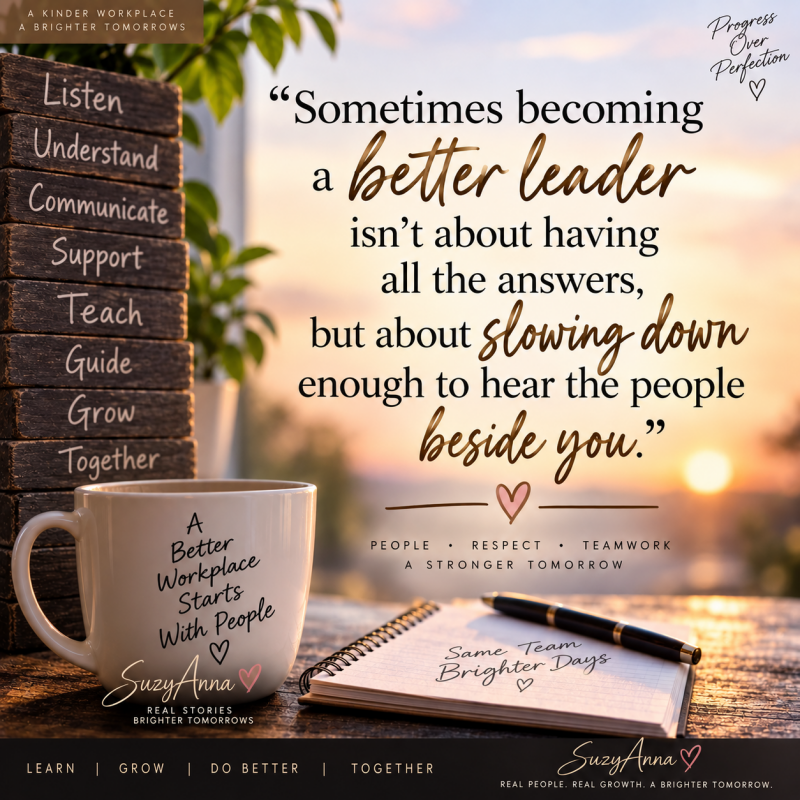
Maybe ceating a better work ethic and a healthier work environment starts with slowing down enough to know one another.
Not knowing everyone's private business.
Just remembering that we're working beside human beings.
Ask questions.
Teach.
Train.
Listen.
Communicate expectations.
Give people opportunities to improve.
Hold people accountable when necessary.
Respect one another enough to handle disagreements appropriately.
And when you're wrong, be willing to admit it.
We don't have to agree on everything to work together.
Leadership shouldn't be about proving who is right.
It should be about finding solutions together and creating an environment where the people watching us can see that even when leaders disagree, they can communicate, respect one another, and move forward together.
And Give Yourself Some Grace Too
Before you judge yourself too harshly, remember:
You're learning.
You're allowed to make mistakes while you're learning.
I made mistakes this week.
I caught them.
Now I have a choice.
I can beat myself up over them, or I can acknowledge them, learn from them, fix what I can, and try to do better next time.
None of us are perfect.
Not our associates.
Not our coworkers.
Not other leaders.
And certainly not me.
What matters is what we do after we recognize that something needs to change.
Did you listen?
Did you accept feedback?
Did you apologize when necessary?
Did you correct your behavior?
Did you learn something?
Will you handle it differently next time?
Then don't be so hard on yourself.
You recognized something in yourself that needed to change, and instead of defending it, you decided to work on it.
That's growth.
Maybe that's what this new position is really teaching me.
I thought my responsibility was to learn my department and develop the people within it.
And it is.
But one of those people is me.
I'm still learning.
I'm still being taught.
I'm still making mistakes.
I'm still growing.
The title didn't mean I had arrived.
The title was just the beginning.
Because sometimes becoming a better leader isn't about learning how to lead everyone else.
Sometimes it's learning how to lead yourself.
Add comment
Comments